What happens if you buy QQQ only after it has been cut in half, and buy more each time it halves again?
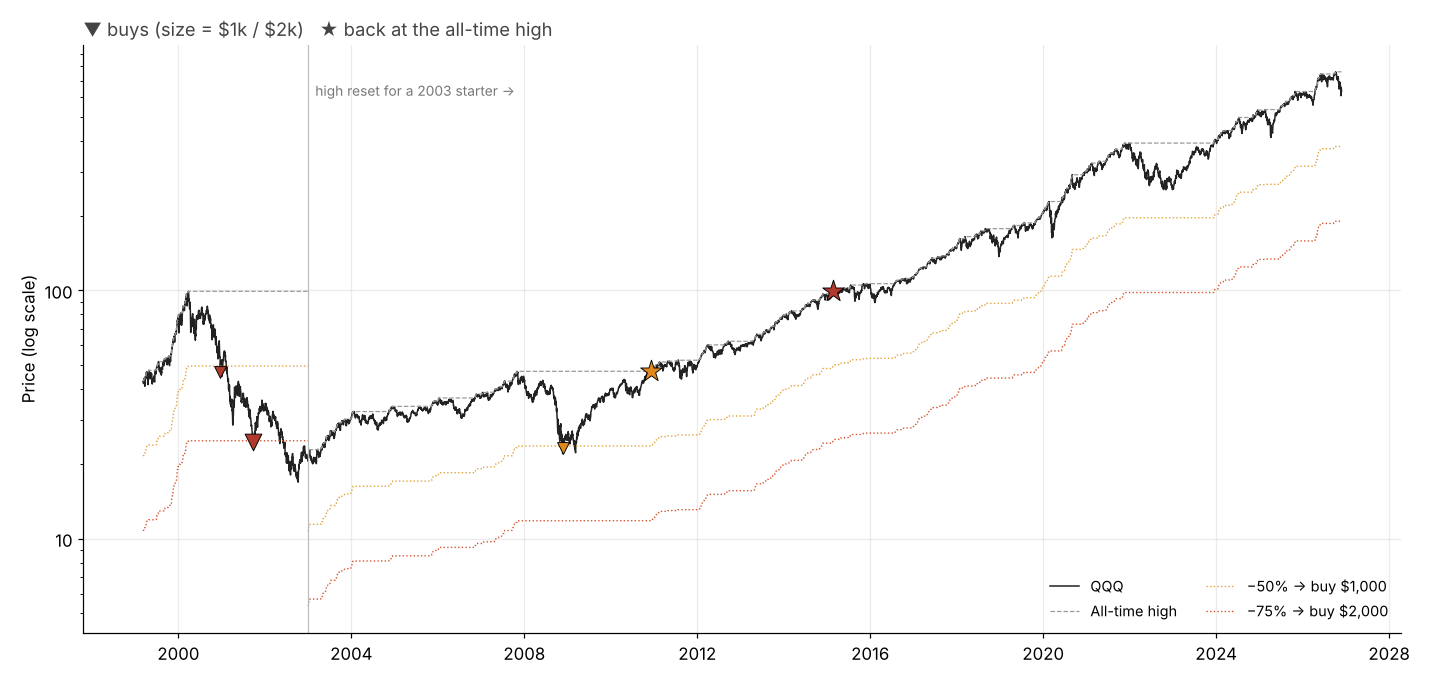
The rule. When QQQ closes 50% below its all-time high, buy $1,000.
If it halves again (−75% from the high), buy $2,000.
Hold until QQQ closes back at that high. At most $3,000 goes in per sell-off.
Where QQQ is now (Nov 25, 2026): $633.93, −16.6% from its closing high of $759.66 (Oct 6, 2026).
Buy levels from that high: −50% = $379.83 ($1,000) · −75% = $189.91 ($2,000). No buy level has been hit since this high.
Key findings
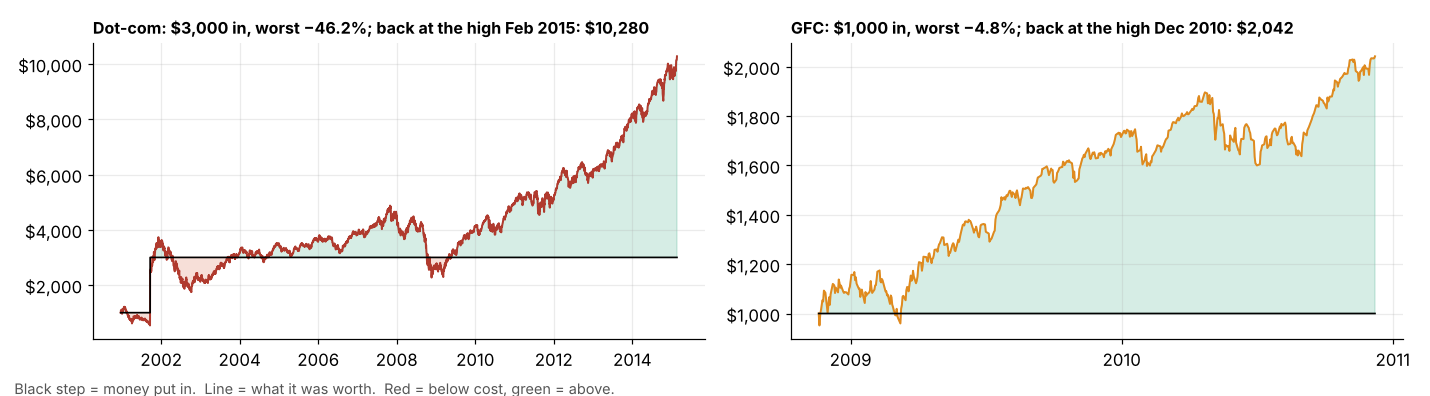
- The rule fired in 2 sell-offs: the first buy ($1,000) every time, and the second ($2,000, at −75%) in 1.
- In the 2 that ended, the money came back as ×2.04 to ×3.43 by the day QQQ regained its old high, which took 2.1 to 14.2 years from the first buy (median 8.1).
- The worst ride was Dot-com: $3,000 put in fell to $1,613 (−46.2%) in September 2001.
- The longest wait was Dot-com: 14.2 years.
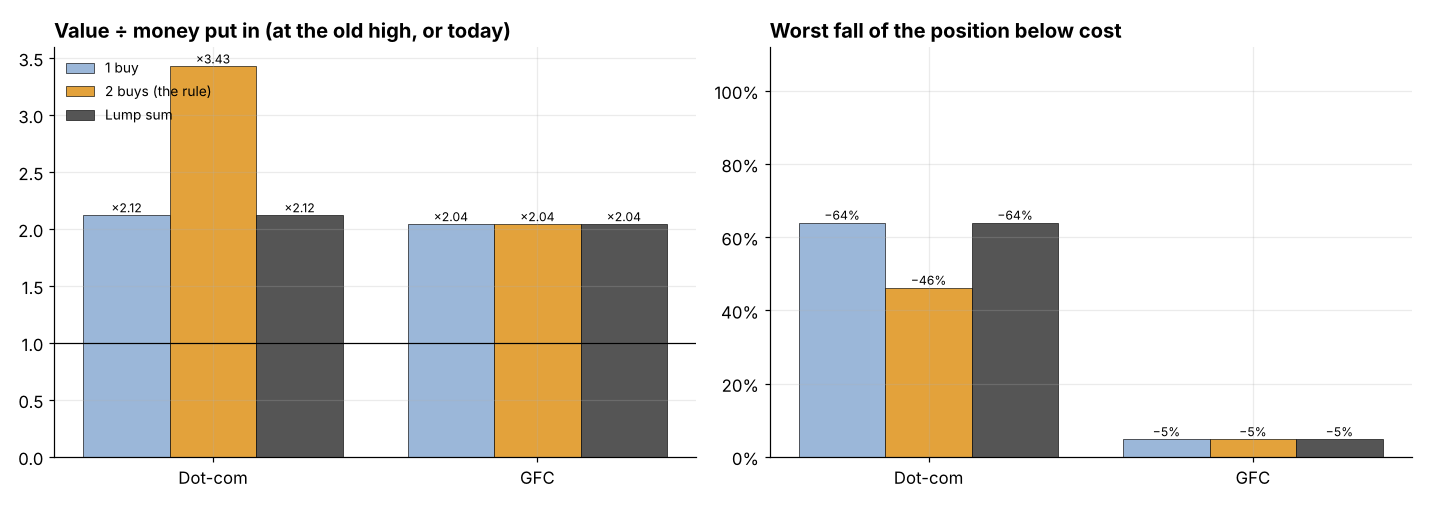
- Doubling down helps most when the fall keeps going. In Dot-com, the two-step rule turned $3,000 into ×3.43, against ×2.12 for putting all $3,000 in at −50%: the later, larger buys come in at a quarter of the high.
Every sell-off that triggered the rule
Worst = lowest value of the position against the money in at that point. Above cost for good = the day after the last close below cost.
Back at high = first close at or above the all-time high the fall started from. Worth then = the position on that day (or today, if not back yet).
If held to today = the same shares valued at the last close. The dot-com row is for someone watching since 1999; every later row is for someone who
started in 2003, after the bust (a 1999 holder still measures from the March 2000 high, so for them the later sell-offs are not new signals).
The whole history
Each sell-off, dollar by dollar
Is doubling down better than the alternatives?
Same trigger levels, different amounts: only the first buy, both, or all $3,000 at once at −50%.
How this was computed
- Daily adjusted closes from Yahoo Finance (dividends reinvested), March 1999 to November 25, 2026. Buys happen at the close of the first day a level is reached; a gap down can fill a level below it.
- No taxes, trading costs, or interest on cash waiting to be invested.
- A backward look at a handful of episodes, not advice. The sample is small, and the dot-com bust shows how long “eventually” can be.
See also: TQQQ: Buying the Halvings · Market snapshot